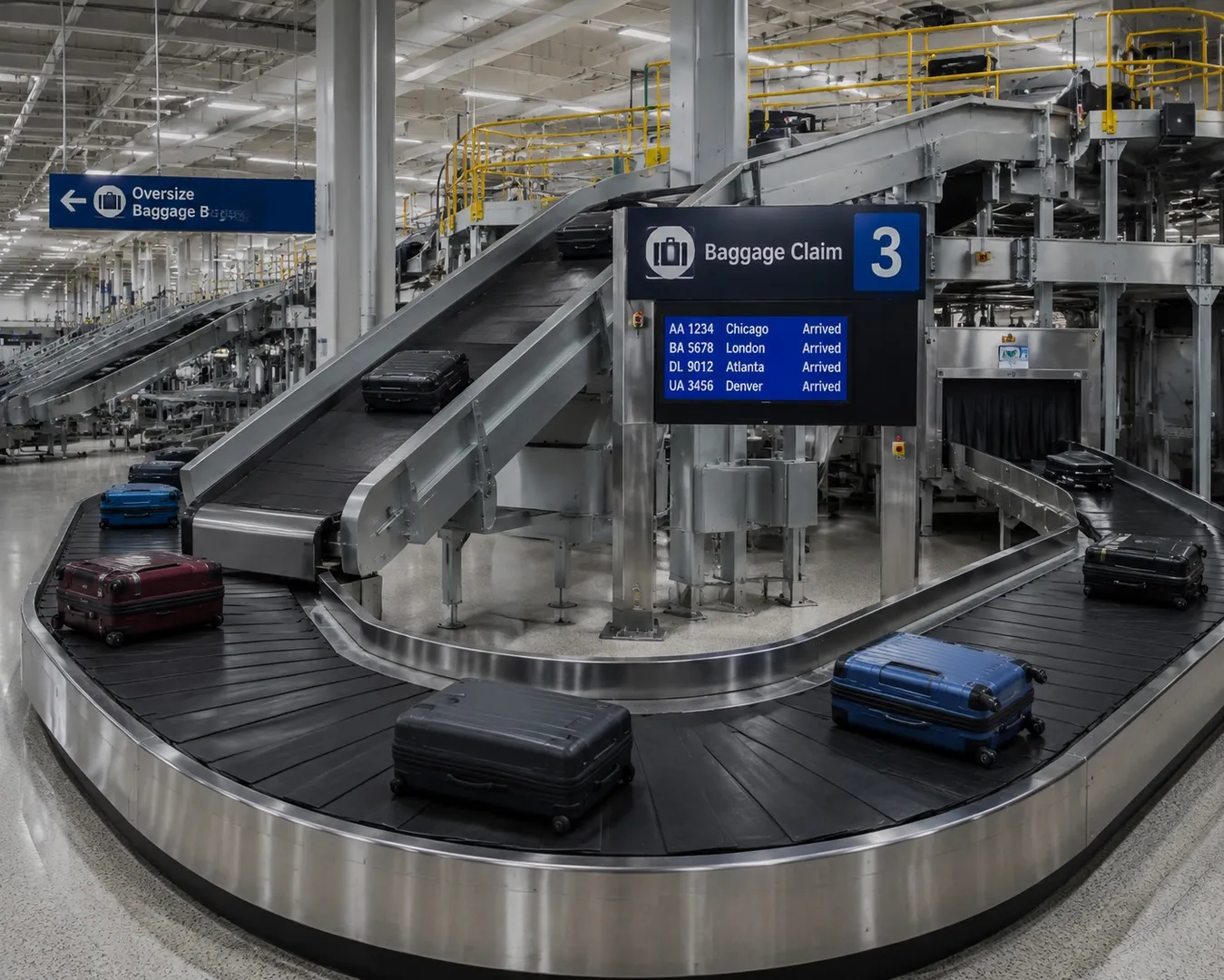
Airport baggage handling involves a very different set of priorities from conventional bulk-material conveying. Bags vary in dimensions, weight, shape, surface texture, and stability, yet they must move through operational areas in an organized manner. An Airport Baggage Conveyor therefore needs to be evaluated as part of a coordinated handling process rather than as a standalone belt.
For airport-related facilities and aviation infrastructure projects around Delhi and the NCR region, reliability, layout compatibility, safe handling, and maintainability are central considerations.
Start With the Baggage Flow
The first question should be where the baggage is coming from and where it needs to go.
Conveyor sections may be required around check-in areas, transfer points, inspection processes, loading operations, or baggage reclaim systems. Each position can create different design requirements.
A project team should map the intended flow before specifying conveyor dimensions.
Account for Irregular Loads
Unlike uniform cartons in a factory, passenger baggage can include hard-shell suitcases, soft bags, wheeled luggage, and items with straps or handles.
The conveyor should therefore be selected with realistic baggage dimensions and weights in mind.
Important parameters include:
- Belt width
- Conveyor speed
- Load capacity
- Transfer arrangement
- Side guidance where required
- Working height
- Drive configuration
- Emergency and operational controls
- Maintenance accessibility
Smooth transfer between adjoining conveyor sections is especially important because poorly planned gaps or level changes can disrupt baggage movement.
Reliability Must Include Maintainability
High equipment availability is valuable, but maintainability also deserves attention during procurement.
Components that can be inspected and serviced without unnecessarily complicated access make routine maintenance easier. Project planners should consider drive access, belt adjustment, roller replacement, cleaning requirements, and electrical-control accessibility.
Spare-component planning is another practical consideration for installations expected to operate for extended hours.
Integration Determines Overall Performance
A technically capable conveyor may still perform poorly if it does not integrate correctly with surrounding baggage-handling equipment.
Dimensions, speed, transfer height, controls, sensors, and sequencing should be coordinated at the system-design stage.
Sunrise Conveyors manufactures material-handling equipment for application-specific requirements, including conveyor configurations where layout and operating conditions determine the final specification.
Organizations sourcing an Airport Baggage Conveyor for Delhi-area projects should prepare layout drawings, expected baggage dimensions, throughput requirements, transfer points, operating hours, and integration details before requesting a final proposal.
This information allows manufacturers to evaluate the application more accurately.
Airport baggage movement depends on many connected components working as one process. Selecting conveyors around actual passenger-baggage characteristics, operational requirements, maintenance access, and integration needs creates a stronger foundation for dependable terminal handling.
Keywords