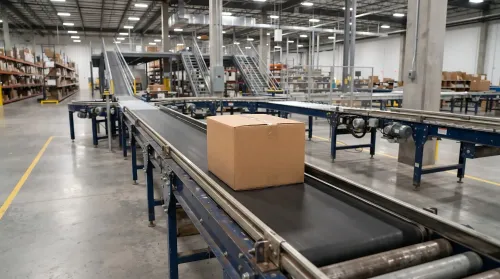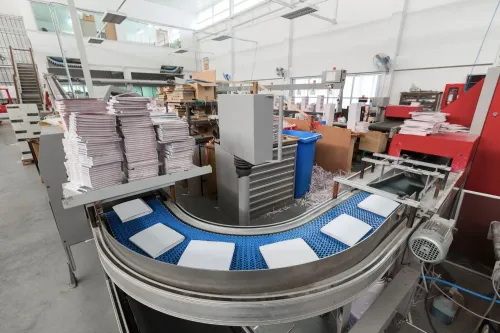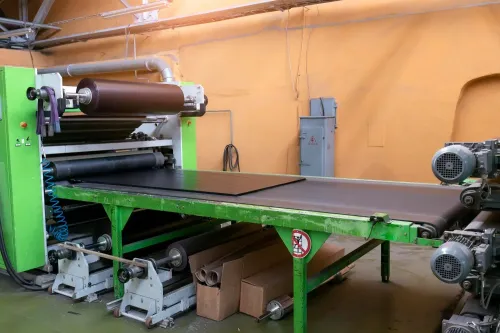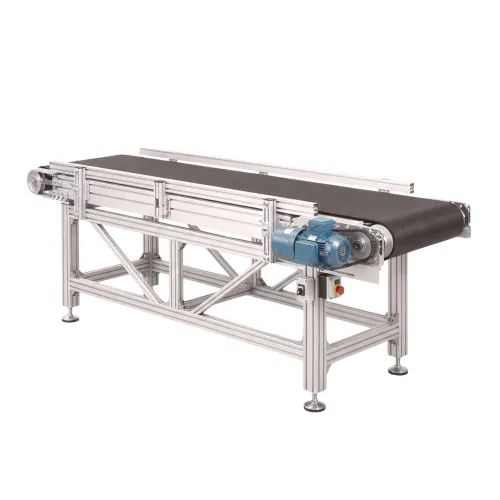
The right conveyor depends on whether your line needs simple transport or a repeatable product presentation for coding, labelling, inspection, or packing. By comparing product behaviour, print-control requirements, accumulation, and maintenance, you can select packaging conveyor options without treating a printer-ready belt as a universal solution.
Key takeaways
- Choose repeatable package positioning over conveyor labels when printing accuracy matters.
- Match belt width, speed, and guides to the package and print face.
- Calculate usable throughput from spacing and print-cycle limits, not belt speed alone.
- Use tracking, support, and spacing controls to prevent skew, smudging, and jams.
What actually makes a printing conveyor different from a standard belt conveyor?
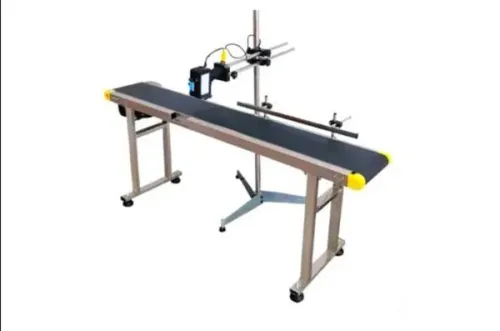
A printing belt conveyor is usually not a separate conveyor class. It is a standard belt conveyor configured to present each package at a repeatable position beneath an inkjet, laser, thermal-transfer, or print-and-apply head.
The right printing belt conveyor for comparison with a standard model is therefore defined by the printer, sensors, encoder, and mounting arrangement as much as by the belt.
The configuration may include:
- A belt surface and colour that provide grip, stable sensor contrast, and clean product release
- Accurate tracking, controlled speed, and a shaft encoder to preserve dot spacing, character width, barcode dimensions, and print position
- Side guides that prevent lateral movement without touching the print face
- Transfers designed to prevent vibration, gaps, or height changes beneath the printhead
- Vacuum hold-down for light pouches, film, labels, or sheets that could lift or shift
- A product sensor with repeatable detection and a specified distance from sensor to printhead, allowing the controller to calculate firing timing
A nameplate speed alone proves little. If belt velocity changes, the code can stretch, compress, or land in the wrong place even when the conveyor transports packages smoothly. Product height, spacing, and reject response also affect registration.
Choose a standard belt conveyor for simple transport, buffering, or accumulation when products do not need controlled presentation for marking. The added guides, encoder, sensing, and alignment control of a printing configuration bring cost and maintenance demands that provide no benefit when print placement is not required.
Match the conveyor to the package, print face, and line rate
Choose the conveyor from the package’s print face and product pitch, not from belt speed alone. These packaging conveyor options suit different formats:
| Format | Conveyor choice | Print concern |
|---|---|---|
| Cartons, folded cartons, trays | Smooth continuous belt; guides for skew | Keep the usable print face flat and exposed |
| Pouches and flexible film | High-grip belt or vacuum belt | Film can wrinkle, slide, or present a curved target |
| Bottles | Guided belt or modular belt | Round surfaces need controlled orientation and print distance |
| Labels and sheets | Smooth belt with vacuum hold-down | Suction prevents lift, curl, and double feeding |
A belt conveyor for packaging must match these points:
- Measure product length, width, height, weight, shape, orientation, and centre-to-centre spacing.
- Specify belt width, texture, colour, pulley diameter, tension range, tracking method, and the usable print face.
- Use a smooth continuous belt for a uniform print path; choose a modular belt when washdown, drainage, or a positive transfer matters.
- Add cleats or flights for inclines, side guides for unstable loads, and vacuum hold-down for lightweight flat packs. Each can block the print target, rub film or labels, or alter orientation.
- Check packages per minute as belt speed divided by centre-to-centre pitch, then allow for sensor delay, print time, reject spacing, and accumulation gaps. Use encoder feedback when speed varies.
Porous, dusty, wet, glossy, curved, or low-energy surfaces can demand different ink, pretreatment, drying time, printhead distance, or marking technology. A suitable conveyor cannot fix poor adhesion or illegible codes.
Calculate usable throughput before choosing belt speed
Nameplate speed predicts only theoretical travel, not usable packaging throughput. Calculate packages per minute as belt speed divided by centre-to-centre product pitch, using matching units: 30 m/min ÷ 0.5 m pitch = 60 packages/min. That figure falls when sensor delay, print time, reject spacing, or accumulation gaps consume the available pitch.
| Planning factor | What it changes | What to verify |
|---|---|---|
| Product detection | Starts print timing; late or inconsistent detection shifts codes | Sensor repeatability, target contrast, and sensor-to-printhead distance |
| Belt velocity | Changes dot spacing, character width, barcode dimensions, and print position | Stable speed or shaft encoder feedback |
| Package presentation | Alters label placement and code legibility | Height variation, lateral movement, skew, and surface position |
| Reject response | Determines whether a failed pack is removed before release | Device response time and minimum reject spacing |
A printing belt conveyor needs the printer to follow actual shaft movement when belt speed fluctuates. Without encoder compensation, acceleration, slip, or uneven loading stretches or compresses printed features even if the package reaches the printhead.
Build the rate calculation around the slowest event, not the conveyor’s maximum. Allow space for:
- sensor delay and print duration
- reject-device response and safe separation
- controlled release from accumulation
A belt that transports cartons well can still produce inconsistent codes if products arrive at different heights, drift sideways, or trigger the sensor at different points. In a printing conveyor comparison, choose repeatable presentation over a higher nameplate speed; a standard belt may move more product but deliver less usable output.
Prevent skew, smudging, jams, and unstable spacing at the print station
A printing station becomes unreliable when the product moves differently from one cycle to the next. Check belt wander at both pulleys, confirm equal tension across the belt, and inspect for slipping between the drive pulley and belt.
Skewed products, changing print-head distance, blocked vacuum holes, and vibration at transfers can shift codes or smear wet ink.
Use this troubleshooting sequence:
- Square side guides to the belt and adjust them until cartons, pouches, or bottles track without rubbing.
- Replace worn belts and remove oil, dust, or moisture that causes slipping.
- Clean vacuum holes and confirm hold-down airflow across the print zone.
- Bridge transfers or reduce their gap when product noses dip, bounce, or rotate.
- Separate double feeds and reset sensors when spacing before the coder becomes unstable.
- Clear jams only after stopping and isolating the conveyor; a jammed product can alter head distance for every following item.
Accumulation choice affects label and code quality:
| Option | Main risk or benefit | Use when |
|---|---|---|
| Direct accumulation on a standard belt | Backpressure, scuffing, label damage, uneven release | Packages tolerate contact and print presentation is not controlled |
| Low-pressure accumulation | Limits contact force and protects surfaces | Packages need buffering with reduced rubbing |
| Zero-pressure accumulation | Releases products in controlled gaps | Printing, inspection, or fragile labels require consistent spacing |
A camera or code verifier catches missing, unreadable, or incorrect marks; the printer alone cannot. Time the reject station to the actual product gap and stability, or a correctly detected failure will pass through. This printing conveyor comparison belongs in any belt conveyor for packaging decision involving regulated or operationally critical codes.
Choose the conveyor configuration by application zone
Use packaging conveyor options by zone, not one frame for the whole line. A robust standard belt suits transport and buffering; use a controlled-gap belt for printing or inspection, low-pressure or zero-pressure accumulation for queues, and cleats or side guides for inclines.
| Option | Best zone | Main specification |
|---|---|---|
| Standard belt | Transport or buffering | Durable surface, tracking adjustment, simple transfers |
| Controlled-gap belt | Printing or inspection | Encoder provision, product sensor, guides, stable spacing |
| Low- or zero-pressure conveyor | Accumulation | Controlled release, limited contact force, reduced scuffing |
| Cleated or side-guided belt | Inclines | Traction and orientation without blocking the print face |
For food or pharmaceutical packaging, confirm resistance to the cleaning chemicals, moisture, temperature, and product-contact exposure. FDA 21 CFR 177.2600 covers rubber articles intended for repeated use; it is not blanket evidence for the complete belt assembly, lubricants, coatings, or supports. Guard pulley, take-up, transfer, and adjacent-equipment nip points.
Specify emergency stops, lockout points, and maintenance access that does not require reaching into moving parts.
Give the supplier product dimensions, weight, surface, orientation, pitch, line rate, incline, cleaning regime, print-face location, allowable contact force, transfer gaps, and accumulation length. Also request belt material evidence, tracking adjustment, transfer design, guide positions, encoder mounting, sensor locations, and reject access.
Sunrise Conveyors can compare these details against the actual packaging line, including belt materials, transfers, guides, encoder provisions, and accumulation, rather than forcing a universal design.
Related products
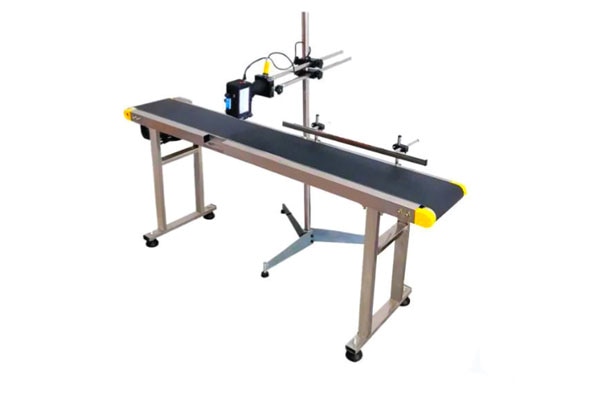 | Material Handling Equipment A print conveyor is a specialized conveyor system used in printing and packaging industries to transport printed materials smoothly between different... View product → |
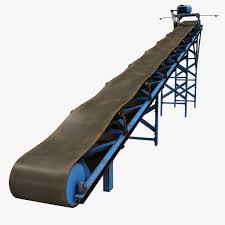 | Industrial Conveyor System Belt Conveyor is a durable and efficient material handling system designed for smooth and continuous transportation of bulk materials and goods. View product → |
Frequently asked questions
What makes a printing belt conveyor different from a standard belt conveyor?
A printing belt conveyor is usually a standard belt conveyor configured for repeatable package positioning beneath an inkjet, laser, thermal-transfer, or print-and-apply head.
How do you match a conveyor to the package and print face?
Check package dimensions, surface, print-face location, required orientation, belt width, guide position, and line rate before selecting the conveyor.
How do you calculate usable throughput before choosing belt speed?
Base throughput on package length, gap, stable spacing, print-cycle time, and the printer’s allowable rate rather than belt speed alone.
How can you prevent skew, smudging, jams, and unstable spacing?
Use suitable belts, side guides, transfers, spacing controls, and print-station support so packages remain aligned and separated through printing.
Related products
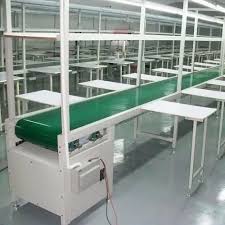 | Assembly Line Belt Conveyor Assembly Line Belt Conveyor is designed for smooth, continuous, and efficient movement of products along assembly and production lines. View product → |
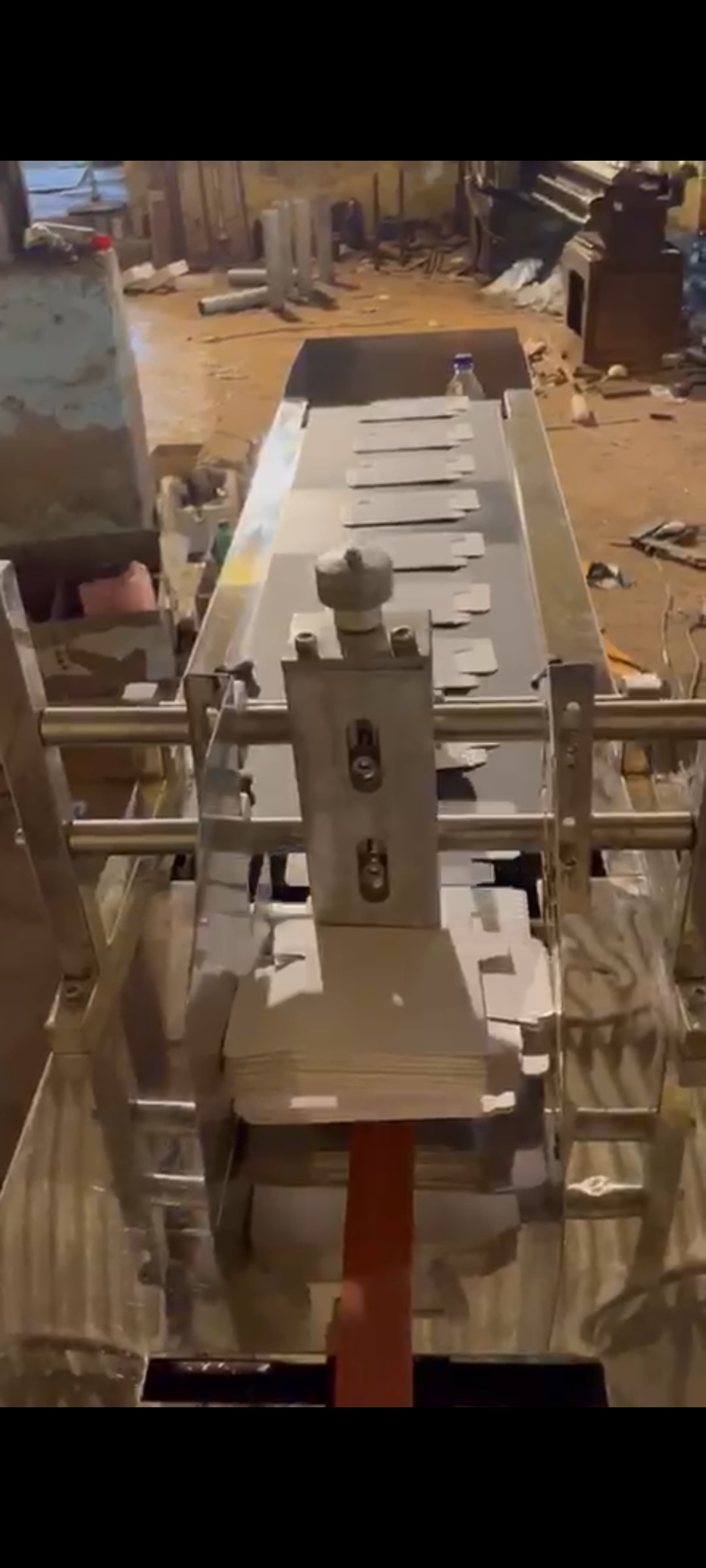 | Material Handling Equipment Stacker Conveyor For Coding And Batch Printing A stacker / destacker conveyor is designed to automatically stack or separate products during material handling operations. View product → |
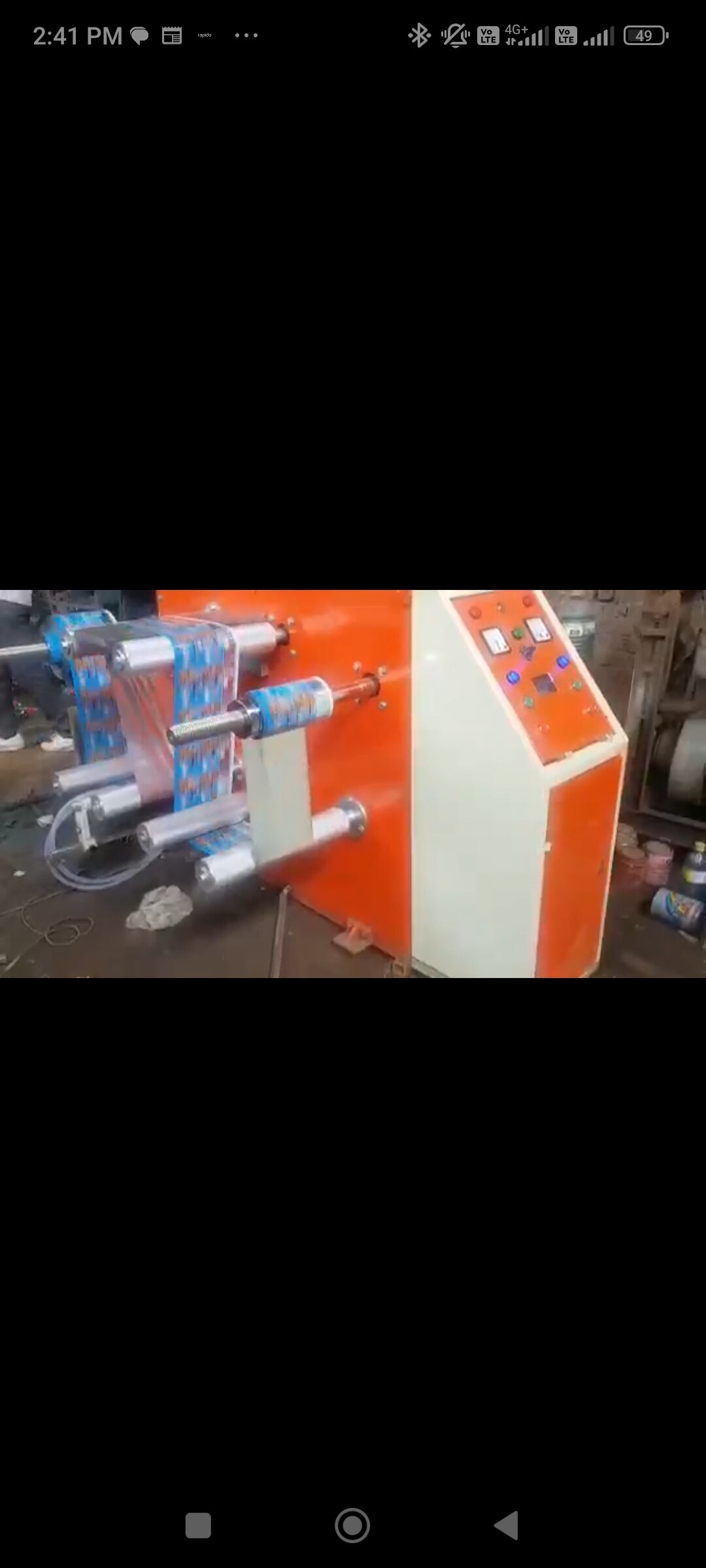 | Material Handling Equipment Rewinding Machine For Batch Coding A winder / rewinder conveyor is used to wind or rewind materials such as films, paper, foil, or sheets in a controlled manner. View product → |
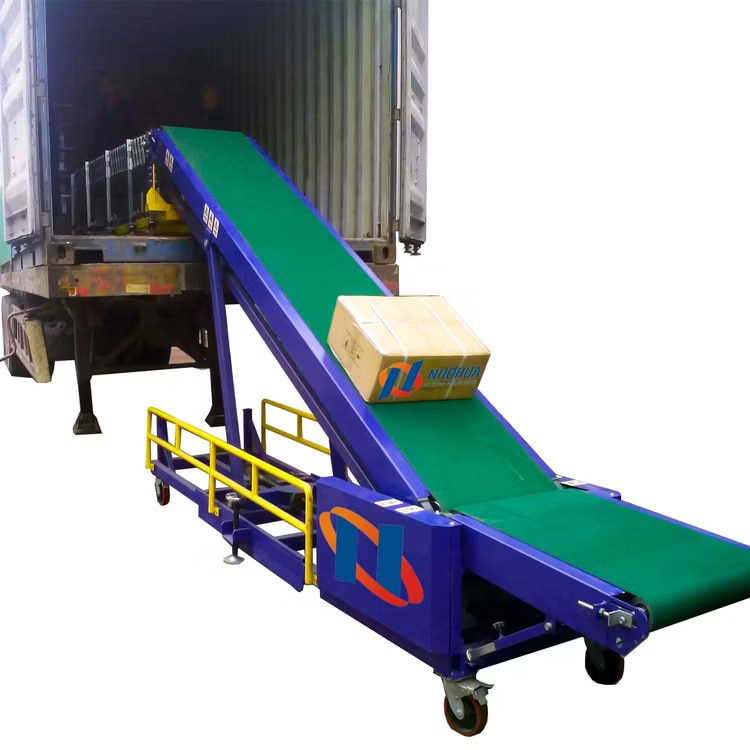 | Material Handling Equipment Loading and unloading conveyors are material handling systems used to move goods efficiently during loading and unloading operations. View product → |
Keywords