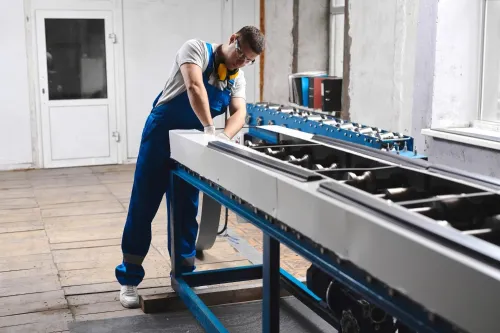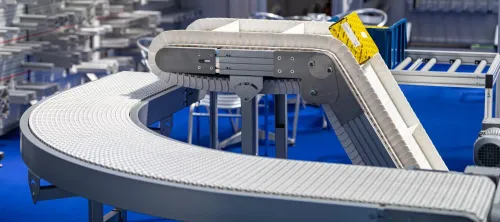
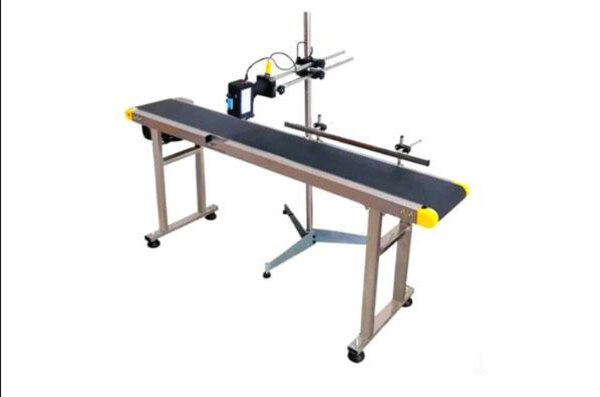
Retail printing becomes difficult when cartons arrive at uneven intervals, turn away from the printhead, or move at different speeds. By comparing product handling, print requirements, control features, changeover effort, and installation conditions, you can decide whether a conveyor is justified or whether another labelling or printing method fits better.
Key takeaways
- Choose a printing conveyor for stable packs, repeatable spacing, and a defined print position.
- Match belt width, speed, load, printer clearance, and encoder control to your production line.
- Use guides or fixtures when packs rotate, vary in size, or need precise print placement.
- Request site trials, safety documents, service coverage, and spare-parts commitments from Delhi-NCR suppliers.
Which Retail Operations Benefit from a Printing Belt Conveyor?
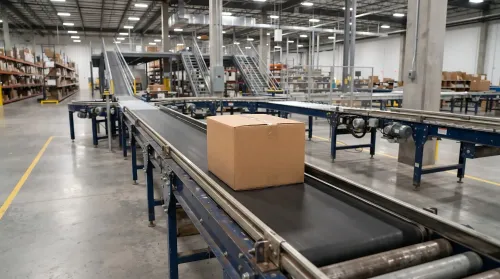
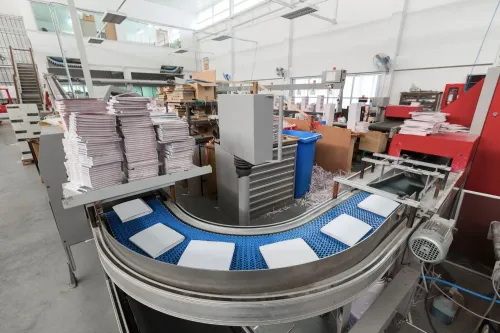
A printing belt conveyor for retail suits operations with repeatable product geometry, measurable throughput, and a clear print location. It carries cartons or packs beneath an inkjet, thermal, UV, or other printer, holds each item at a fixed position, then transfers marked goods to inspection, packing, or sorting.
The strongest fits include:
| Operation | Practical use | Fit signal |
|---|---|---|
| In-store label printing | Present packs for direct codes or graphics | Stable pack size |
| Retail distribution centres | Code cartons before sortation | Measured flow |
| E-commerce fulfilment | Mark orders or shipping packs | Controlled spacing |
| Promotional-product production | Print logos or identifiers | Consistent product face |
| Packaging lines | Code packs before case packing | Known speed and surface |
| High-volume price marking | Print prices or batch data | Low manual repositioning |
Judge the printing belt conveyor against labour spent positioning products, stoppages caused by missed prints, and the time needed for barcode, contrast, and code checks. A general belt is a better starting point when those controls add complexity without reducing repeated handling.
It is a poor choice for:
- Very low-volume work
- Hand-fed products that constantly change orientation
- Fragile goods needing individual support
- Products requiring several print faces
- Operations needing print-and-apply labels instead of direct printing
How Is a Printing Conveyor Different from Other Retail Conveyors?
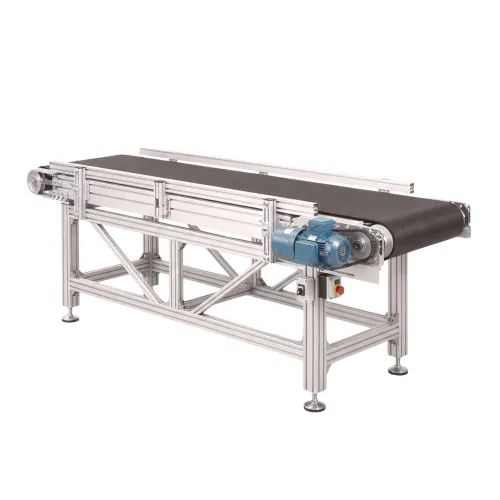
A printing conveyor is part of the print process, not merely a route past a printer. A standard belt conveyor may move cartons reliably yet lack speed feedback, a rigid print zone, product guides, printhead-height adjustment, encoder connection, printer interlocks, inspection-camera mounts, and reject handling.
The printing belt conveyor must hold each product at a repeatable distance and orientation while limiting vibration, belt wander, and splice height.
| Option | What it does | When it applies |
|---|---|---|
| Roller conveyor | Moves products but allows small packs to rotate or bounce | Stable cartons with noncritical print orientation |
| Print-and-apply labelling machine | Dispenses and attaches labels rather than printing directly on the product | Operations requiring applied labels |
| Standard flat-belt conveyor | Transports products without dedicated print interfaces | General movement away from the print zone |
| Fixture printing conveyor | Locates each item in a defined position | Unstable or irregular products |
Use guides, side rails, cleats, timing belts, or metering devices when product geometry is consistent and the print face stays stable. Choose a fixture printing conveyor when bottles, tubes, pouches, cylindrical products, lightweight packs, or promotional items shift on a flat belt.
Fixtures add tooling, cleaning, and changeover work, and poorly designed contact surfaces can mark products.
What Happens to Retail Packs During the Printing Workflow?
Each pack must arrive at the printhead at a known position, height, and speed. A printing belt conveyor turns a loose stream into a controlled sequence, then sends marked packs to inspection, accumulation, packing, or sorting.
1. Loading places cartons or packs on the belt. If products arrive touching, a metering belt separates them; side guides steady packs that drift or arrive skewed.
2. Singulation and spacing use a timing belt, metering belt, or indexing stop to create the gap required by the printer. Uneven intervals become repeatable pitch.
3. Photoelectric sensors detect each pack and identify gaps, missing products, upside-down items, or a pack that has not cleared the previous station. Recipe-based controls apply the correct timing for each SKU.
4. An electronic or line-shaft encoder supplies belt speed to the printer. Without that reference, acceleration, deceleration, or belt slip can stretch or compress the image along the travel direction.
5. Printing can run continuously or at indexed stops. Continuous movement gives smoother flow and fewer stop-start shocks; indexed movement improves placement on short codes or inconsistent packs but adds control complexity, noise, and cycle time.
6. Verification checks barcode readability, print contrast, batch or lot-code capture, and inspection-camera access. A failed image must trigger a reject.
7. Reject confirmation proves the bad pack left the good-product stream. Accumulation then absorbs downstream pauses before packing or sorting.
8. Provide a guarded, operator-accessible method for clearing misfeeds without bypassing the printer interlock or safety circuit.
Which Specifications Decide Whether the Conveyor Will Work?
Require product drawings or samples before comparing a printing conveyor. Record:
- Length, width, height, weight range, surface material, flat or irregular print faces, and permitted movement such as rotation, skew, or sliding.
- Belt width, usable print area, printhead clearance, rigid support at the print zone, guide adjustment, indexing accuracy, and connection to sensors and the printer controller.
| Printing conveyor | Best fit | Check before purchase |
|---|---|---|
| Basic transport belt | Stable cartons with fixed orientation | Add guides, encoder, printhead mount, and interlocks if absent |
| Printing belt conveyor | Repeatable direct printing on packs | Confirm speed control, support, clearance, and usable print area |
| Fixture printing conveyor | Bottles, tubes, pouches, or irregular products | Price fixtures, cleaning, tooling, and changeover time |
State products per minute alongside print resolution, image length, curing or drying time, and acceptance criteria. A maximum belt-speed figure means nothing without those conditions.
Ask how each SKU changes over: guide adjustment, fixture replacement, belt cleaning, recipe selection, printer-height adjustment, and test-print approval.
Check belt compatibility with ink, solvents, detergents, heat, UV exposure, and the product surface. A strong belt can still swell, transfer pigment, lose grip, or release freshly printed packs poorly.
What Installation, Safety, and Maintenance Checks Matter in Retail Sites?
Reliable operation in a back room or distribution facility starts with site fit, not belt speed. Confirm floor space, conveyor elevation, loading and jam-removal access, electrical supply, compressed-air requirements, controls architecture, upstream spacing, downstream accumulation, and the route for rejected products.
Use this installation checklist:
- Match the printing belt conveyor to the printer, sensors, encoder, inspection camera, and reject device.
- Guard drive components, belt-return areas, accessible nip points, and the print station.
- Provide reachable emergency stops and define what happens after reset: who restarts the line, and whether products require reinspection.
- Apply ISO 12100 for the machinery risk assessment and ISO 13849-1 for safety-related control design. An emergency-stop button alone is not a complete safeguard.
Maintenance must cover belt tracking, splice condition, sensor cleaning, printhead access, ink or overspray contamination, wear-part replacement, and inspection-camera cleaning. Wandering changes print position; a raised splice can disturb packs or fixtures.
Compare manual positioning with automation using measurable costs:
| Measure | Manual positioning | Automation |
|---|---|---|
| Labour | Operator time | Control and maintenance time |
| Quality | Rework, discarded packs, missed codes | Quality-control checks |
| Flow | Line stoppages | Accumulation and reject handling |
This avoids savings claims that depend on volume or staffing.
How Should Delhi and NCR Buyers Evaluate a Supplier?
Treat “printing belt conveyor Delhi” as a location search, not a specification. Put these details in the quotation request:
- Print technology, code size, product samples or drawings, weight range, surface material, target speed, products per minute, operating hours, cleaning method, belt width, required print position, printer model, fixture needs, electrical supply, compressed air, environmental conditions, layout, and installation access.
Ask each supplier to run your actual retail packs through a sample test. Record print position, barcode readability, contrast, reject performance, changeover time, and usable speed range. A generic maximum-speed figure proves little without your pack geometry and print settings.
Compare suppliers on evidence and service, not brochures. Sunrise Conveyors belongs in the same evaluation when it supplies a documented test, interface list, maintenance access, and site-specific support terms.
| Criterion | Delhi | Noida | Manesar | Ghaziabad |
|---|---|---|---|---|
| Site measurement | Confirm travel and survey date | Confirm NCR coverage | Confirm industrial-site access | Confirm local survey capacity |
| Commissioning and training | Name the attending team | Define included visits | Define shift coverage | Confirm response time |
| Spares and service | List stocked parts | State delivery route | State escalation contact | State service coverage area |
Related product
 | Material Handling Equipment A print conveyor is a specialized conveyor system used in printing and packaging industries to transport printed materials smoothly between different... View product → |
Frequently asked questions
Which retail operations benefit from a printing belt conveyor?
Retail operations benefit when cartons, pouches, bottles, or other packs have repeatable geometry, measurable throughput, and a fixed print location. The conveyor is less suitable for unstable products that shift or rotate before printing.
How is a printing conveyor different from other retail conveyors?
A printing conveyor controls product spacing, orientation, and print-head distance rather than only transporting goods. Encoder feedback, side guides, fixtures, or reject handling may be needed to keep marks legible and correctly positioned.
What happens to retail packs during the printing workflow?
A pack enters the belt, is aligned or held by guides or a fixture, passes the printer at a controlled speed, and moves to inspection, packing, sorting, or rejection. The workflow depends on the printer type, ink curing needs, and required code location.
Which specifications decide whether a printing belt conveyor will work?
Check pack length, width, height, weight, belt width, line speed, spacing, printer clearance, print-head distance, encoder arrangement, frame height, and the required accuracy of the printed mark. Test the smallest and largest packs before purchase.
What should Delhi and NCR buyers check when evaluating a supplier?
Ask for a live or recorded trial using your packs, a layout showing printer and service access, electrical and guarding details, commissioning scope, response times, spare-parts availability, and references for comparable retail installations.
Keywords