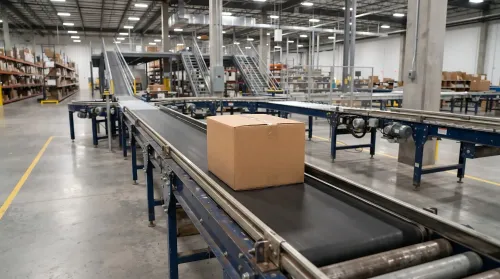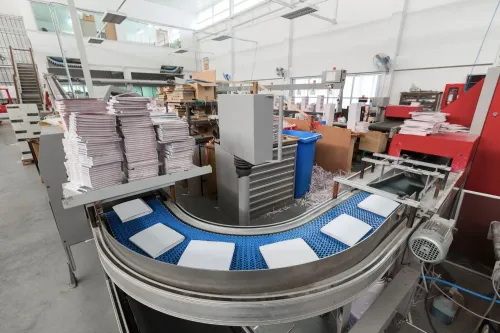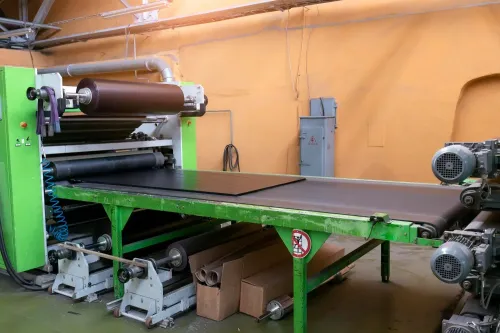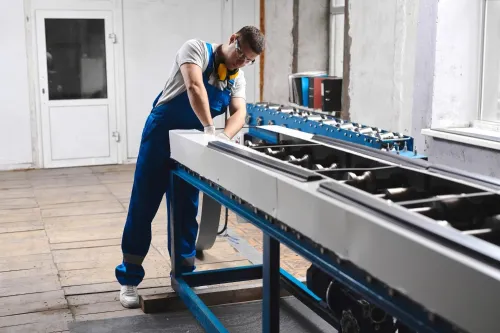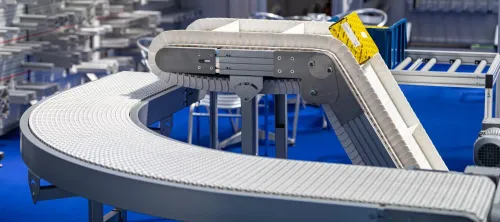
A belt conveyor in a Delhi factory is not limited to moving products from one station to another: it may carry cartons, bags, components, trays, parcels, drums, packaged food or bulk solids through receiving, processing, inspection, packing and dispatch. By the end, you will be able to match each belt conveyor application to the product, route, operating conditions and layout constraints that determine whether it is the right equipment.
Key takeaways
- Use belt conveyors for steady movement between receiving, processing and dispatch.
- Choose flat belts for packages; troughed belts for bulk materials.
- Size capacity from load weight, belt speed, loading rate and incline.
- Use roller, screw or manual handling when belts cannot control the product safely.
Where Delhi factories use belt conveyors from receiving to dispatch
A belt conveyor moves cartons, bags, trays, components and finished packs continuously between workstations, rather than carrying pallets across the factory. For anyone comparing belt conveyor uses in delhi, the useful question is where the product needs steady, controlled movement.
- Receiving: transfer incoming cartons, bags, components or raw materials from unloading points to storage, weighing or production.
- Processing: feed parts through assembly, fabrication, printing, filling or other process stages at a controlled speed.
- Inspection: present products to operators, cameras, metal detectors or checkweighers without repeated manual lifting.
- Packing: move filled containers, packaged food, pharmaceutical packs and FMCG goods to sealing, labelling and coding machines.
- Palletising: accumulate and align finished cartons before a palletiser or manual pallet-building station; the belt itself is not usually the pallet carrier.
- Dispatch: carry sorted parcels and completed orders to staging, loading docks or vehicle-loading points.
These belt conveyor applications span automotive components, sheet-metal lines, food and beverage packing, pharmaceuticals, plastics, recycling, printing and e-commerce order sorting across Delhi and NCR.
A factory handling dusty bulk solids needs transfer chutes, skirt boards, suitable dust extraction, sealed bearings where appropriate and controlled drop heights; a badly adjusted skirt causes spillage, belt-edge wear and excess drive power.
Guard pulley and take-up nip points, provide emergency-stop access, and allow room for cleaning, belt joining, pulley removal and motor maintenance. A belt conveyor is a poor choice for a large vertical lift; use a bucket elevator, vertical reciprocating conveyor, spiral conveyor or properly cleated incline when the route demands it.
Which materials and industries suit belt conveyor applications?
Unit loads that need steady, controlled movement suit belt conveyor applications better than pallet transport. Delhi and NCR factories commonly move cartons, bags, trays, parcels, auto components, sheet-metal parts, paper, packaged food, pharmaceutical packs and plastic products between production, inspection, packing and dispatch.
Common matches include:
- Automotive and fabrication: components, pressings and trimmed sheet metal moving between workstations.
- Food, beverage and pharmaceutical plants: sealed packs, bottles, cartons and trays, with cleanable frames, accessible return runs and corrosion-resistant construction.
- FMCG, printing and e-commerce: cases, printed bundles, parcels and irregular cartons sorted or transferred at controlled speeds.
- Plastics, recycling and building materials: granules, scrap, sand, aggregates and process residues carried on troughed belts.
| Material or industry | Suitable belt use | Main limitation to check |
|---|---|---|
| Unit loads | Flat belt for cartons, bags, trays and components | Rigid-bottom cartons and pallets often suit rollers better |
| Loose bulk solids | Troughed belt for sand, scrap, aggregates and residues | Check bulk density, lump size, loading rate and dust control |
| Food and pharmaceuticals | Hygienic transfer between processing and packing | Stainless steel alone does not prove cleanability or product-contact compliance |
| Inclined products | Cleats, sidewalls or a profiled belt | Speed alone will not stop rollback or product migration |
For belt conveyor Delhi projects, distinguish a Delhi NCT site from wider NCR service coverage. Reserve floor space for belt joining, cleaning, pulley removal, motor access and inspection; a tight footprint can turn routine maintenance into unsafe work.
How to choose the belt, capacity and layout for a Delhi site
Specify the product, flow, route and operating conditions before asking for belt width. The industrial conveyor system Delhi factories specify must match bulk density or product mass, loading rate, belt speed, surcharge angle, inclination, lump size, loading method and duty factor.
A belt conveyor Delhi factory uses for evenly spaced cartons can be badly undersized for irregular bags or bulk solids.
Give the designer these details:
- Product: material name, maximum and minimum dimensions, weight, shape, surface, temperature, moisture, abrasiveness and whether it arrives loose, in bags, cartons, trays or totes.
- Capacity: pieces per minute or tonnes per hour, peak rate, accumulation requirement and required duty hours.
- Route: centreline length, horizontal sections, incline, transfer points, feed method, discharge height and required belt speed.
- Site: available floor space, column locations, ceiling height, cleaning area, belt-joining space, pulley-removal route, motor access and inspection access.
- Controls and safety: emergency-stop locations, guarded pulley nip points, lockout points and controls that prevent unexpected restart.
| Product type | Belt and capacity detail | Layout consequence |
|---|---|---|
| Cartons or totes | Dimensions, weight, spacing and accumulation time | Check transfers, side guides and discharge height |
| Bags or irregular loads | Peak mass flow, bag stability and loading pattern | Allow wider belt or slower speed |
| Bulk solids | Bulk density, lump size, surcharge angle and tonnes per hour | Specify troughing, loading zone and spill control |
For a confined Delhi estate, Sunrise Conveyors can evaluate maintenance clearances alongside the conveyor footprint; a layout that omits them creates unsafe servicing and costly relocation. Reserve another conveying method for large vertical lifts.
Related product
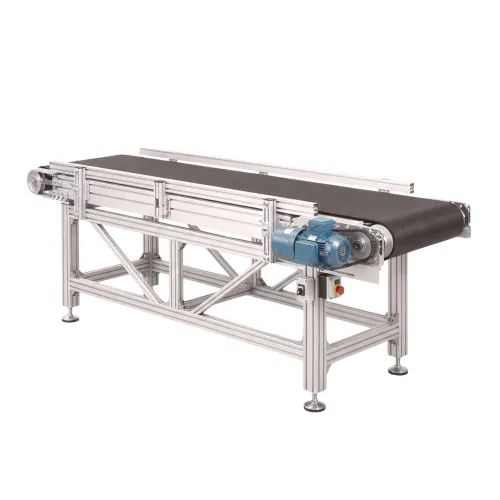
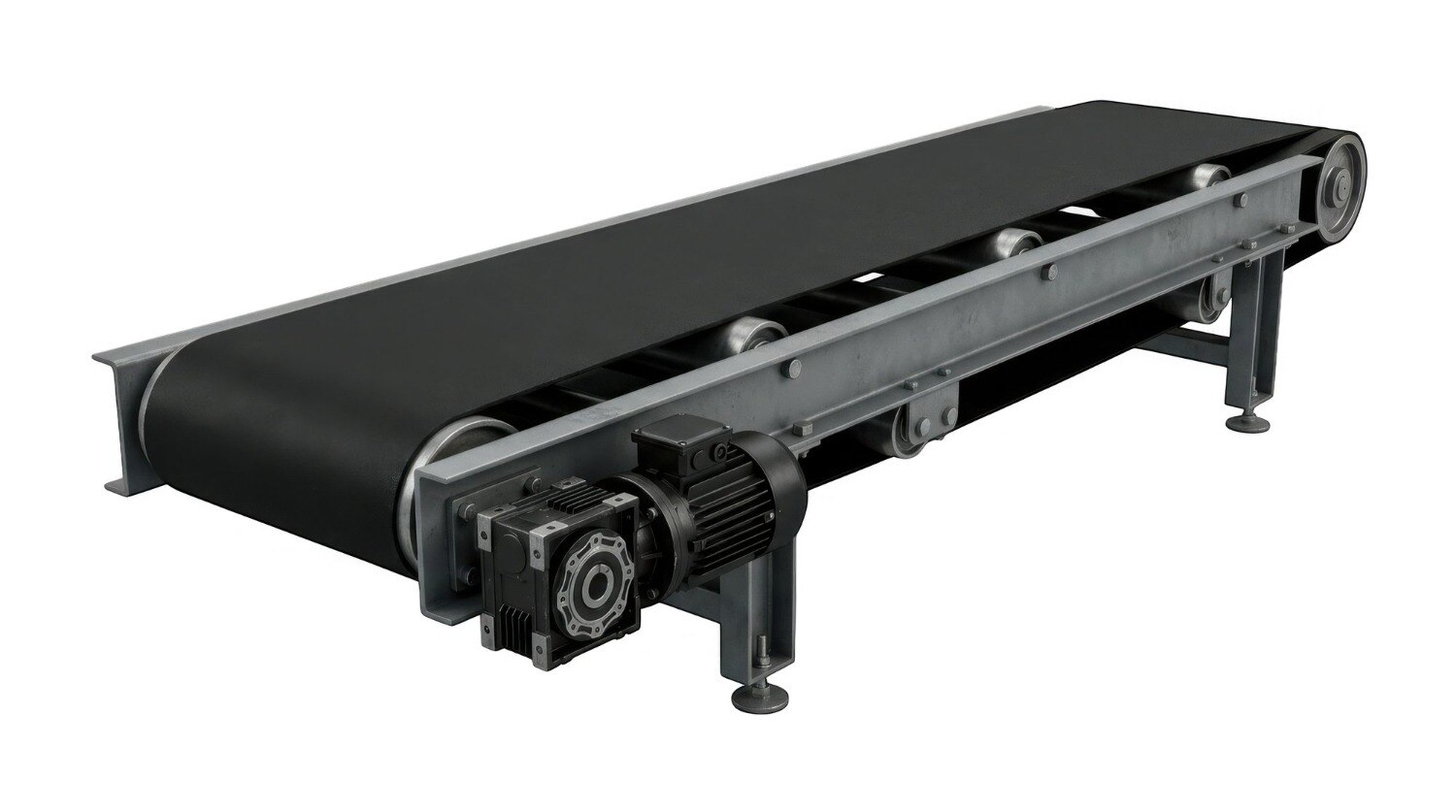
 | Industrial Conveyor System Belt Conveyor is a durable and efficient material handling system designed for smooth and continuous transportation of bulk materials and goods. View product → |
Flat, troughed, cleated or modular: which belt arrangement fits?
Flat belts suit cartons, trays, bags, drums and components; troughed belts suit loose bulk solids; cleats or sidewalls keep loads from sliding on inclines; modular belts suit washdown-sensitive food and pharmaceutical lines.
| Option | Best fit | Main limitation |
|---|---|---|
| Flat belt | Unit loads, parcels, auto components and evenly spaced cartons | Unsecured products migrate on inclines |
| Troughed belt | Aggregates, sand, scrap, grain and process residues | Poor choice for unstable cartons or hygiene-critical contact |
| Cleated or sidewall belt | Inclined bags, cartons, packaged food and controlled elevation changes | Cleats complicate cleaning and product transfer |
| Plastic modular belt | Food, beverage, pharmaceutical and FMCG handling | Hinges and sprockets need inspection and cleaning |
Common belt conveyor applications include sheet-metal lines, packaging, plastics, recycling and order sorting. A flat belt is not automatically suitable for every carton: check its base, centre of gravity and spacing before adding speed.
For an industrial conveyor system in Delhi, specify bulk density or product mass, loading rate, belt speed, surcharge angle, lump size, inclination and duty factor. A conveyor sized for uniform cartons can choke when bags arrive irregularly.
Food and pharmaceutical service demands more than a stainless frame. Check cleanable surfaces, accessible return runs, sealed welds, minimal dead spaces, washdown compatibility, corrosion resistance and product-contact compliance.
Reserve room around the belt for cleaning, belt joining, pulley removal, motor access and inspection. In a cramped Delhi industrial estate, ignoring that clearance turns routine maintenance into unsafe work.
When another conveyor or manual method is the better choice
Choose the alternative when the product, route or handling pattern defeats a belt’s strengths. The best belt conveyor uses in Delhi involve continuous movement of cartons, bags and components; they are not automatically the best solution for pallets, hot material or occasional loading.
| Option | Choose it when | Belt-conveyor limitation avoided |
|---|---|---|
| Roller conveyor | Loads have rigid, flat undersides and need accumulation, such as pallets, totes or cartons | Rollers reduce contact friction and let products queue without continuous belt movement |
| Chain conveyor | Pallets, heavy fixtures, metal bins or oily loads need positive, rugged movement | Chains tolerate concentrated loads that can damage a standard belt |
| Screw conveyor | You are moving powders, sludge or small bulk solids through an enclosed, short route | A screw controls dust and contains the material better than an exposed belt |
| Pneumatic conveying | Fine powders must travel through pipes, rise vertically or cross congested floor space | Airflow removes the need for a long conveyor path, but consumes more energy |
| Forklift | Pallets, drums or irregular loads move between changing locations rather than fixed stations | A forklift provides route flexibility that a fixed conveyor cannot |
| Manual handling | Loads are light, infrequent, fragile or varied, and the travel distance is short | Manual work can cost less than installing equipment for occasional transfers |
A search for belt conveyor delhi suppliers should begin with product geometry and duty, not width alone. For an industrial conveyor system delhi specification, record mass, loading frequency, accumulation needs and floor access; otherwise a cheaper-looking belt can create jams, unsafe lifting or wasted space.
Frequently asked questions
Where do Delhi factories use belt conveyors?
Factories use them for receiving, inspection, sorting, assembly, packing, palletising and dispatch, especially where products move continuously between fixed workstations.
Which materials suit belt conveyor applications?
Belt conveyors suit cartons, bags, trays, components, packaged goods and selected bulk materials. Match the belt surface and construction to weight, shape, temperature and contamination risk.
How do you choose belt capacity and layout for a Delhi site?
Measure product dimensions and weight, required hourly throughput, belt speed, loading points, discharge height, available floor space, incline and maintenance access before sizing the system.
Which belt arrangement fits different factory products?
Use flat belts for stable packages, troughed belts for loose bulk material, cleated belts for inclines or separated products, and modular plastic belts where cleaning or product transfer needs demand it.
When is another conveyor or manual handling method better?
Choose roller conveyors for rigid loads with suitable bases, screw conveyors for enclosed bulk transfer, bucket elevators for vertical movement, and manual handling for low-volume or highly variable work.
Keywords